This post is part of a larger series on how I designed my photography zine, in somewhat agonizing detail. Take a look at the other posts in this series:
- Part I of VI: Forming the Project
- Part II of VI: Early Design Concepts
- Part III of VI: The Design Dirty Work
- Part IV of VI: Editing the Zine
- Part V of VI: Producing the Zine
- Part VI of VI: How to Photograph a Laundromat & Other Thoughts
As soon as I realized my zine would focus on laundromats, I started trying to imagine the finished version in my head. I took to websites like Pinterest and Instagram for examples of others’ zines and saved ones that had elements I liked: a cool cover design, or an insert, or a unique binding idea. I also sought in-person opportunities to look at zines where I could at bookstores, photography shops, and even at a dedicated zine library in Bend, OR.
Early Considerations
The same way I established the scope of which laundromats I would photograph, I also needed to answer a few questions before I could get very far in designing a zine. The most important questions were:
- Who was this project for? How many copies did I want to make?
- How much of the zine production did I want to do myself?
Question #1: I quickly decided to make 29 copies of my zine. I am a few months away from turning 30. In many ways, I view this project as a finale to my 20’s when I started exploring so many of my artistic hobbies. It was both a symbolic choice, and a practical one which would produce enough copies to give to my friends and family.
Question #2: I knew I wanted to print/bind my zine myself because I wanted the challenge and because I could retain more control over the final thing. I spent a lot of time considering the bookbinding method I wanted to use, since this decision would ultimately dictate the final look and feel of the zine in ways such as:
- Number of copies I could feasibly make
- Size of the finished zine & number of pages
- Materials I would be able to use
- Other elements I would be able to include
I eventually settled on using a simple saddle stitch binding for my zine because it is easy and classic. I could make a lot of copies without much additional effort, and saddle stitch binding preserved the possibility of adding an insert or other element into the centerfold of the zine.
Early Design Work
As I wrapped up the list of laundromats I wanted to photograph, I turned my attention to the content that would go into my zine:
Photos: Throughout the process of developing and scanning the photos, I made a habit of exporting photos I particularly liked into a folder on my desktop (unceremoniously called “Laundromat Photos”). They sat there through the duration of my photography. I eventually ordered some inexpensive 4″ x 6″ prints, which I carried around with me. I flipped through them on occasion to familiarize myself with them and to identify the photos that just seemed to go together.
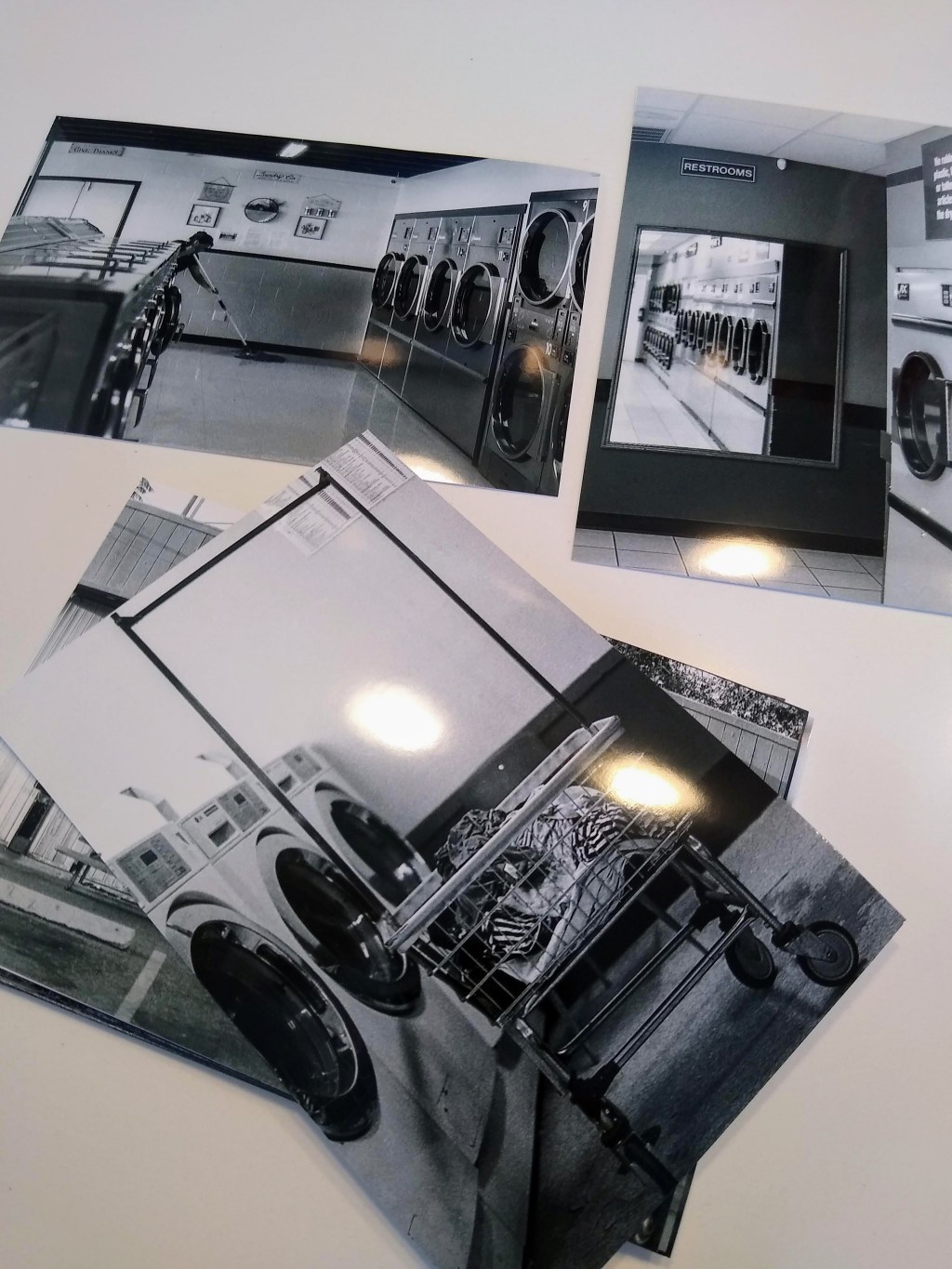
Text: Early on, I also listed the types of text I would likely need for my zine: an introduction, an author bio, and some “reviews” on a few of the laundromats. As I had time, I pulled out my journal and started writing drafts of each of these things without the pressure of producing a final draft. While photographing, I also took a notes on each laundromat using the notes app on my phone to help fill in details later on in the design process.

Flow: I struggled with this part the most. I had to decide the story I wanted to tell, since this could help me outline the arrangement of items within the final zine. Eventually, I decided to loosely follow the order of visiting a laundromat. It was a linear storyline that helped me draw attention to the comparative they’re-all-the-same-yet-different quality that initially drew me to laundromats.
All of this work happened over the course of several weeks at a very casual pace. I had no timeline or goals to meet, and I tried let everything develop as ‘naturally’ as I could. (This is not like me in the slightest, and it required a lot of restraint to not rush towards the end of the project.)
At the same time, these early steps helped focus my vision of the final zine and it made the actual design work a much quicker and simpler process.
 Lora Makes Things
3 responses to “The Making of a Photo Zine: Early Design Concepts (part II of VI)”
[…] Part II of VI: Early Design Concepts […]
LikeLike
[…] Part II of VI: Early Design Concepts […]
LikeLike
[…] Part II of VI: Early Design Concepts […]
LikeLike