Eventually Something Will Stick
December 13, 2023 – This is a zine about spaghetti. In all forms and from all angles. And it springs forth from a summer of insanity. Am I the crazy spaghetti lady? Maybe.
I have been a fully-fledged adult for over a decade now. In that time, I developed a good intuition for the approximate price of goods/services. At least the ones I purchased often, like groceries. However, following three years of economic inflation in the aftermath of the 2019 COVID pandemic, my grocery store Spidey-Sense felt broken. It felt impossible to tell if something was a good deal or not.
Simultaneously, I have a thing for road trips. During most summers, there are only a few weekends where I don’t load myself into my car and fling myself into the outer orbit of all the back roads and small towns I can reach within a comfortable driving distance. Since this last summer felt like the first time it’s been fairly safe to travel, I took full advantage of that.
On these many road trips, one of my favorite pastimes was to stop at grocery stores whenever I needed a bathroom or to stretch my legs. The more unique, the better. I enjoyed perusing the aisles of small town grocery stores that sometimes double as a town’s drug store, hardware store, liquor store, and a little bit of everything else. I found that ethnic and natural grocers often have excellent deli sections and usually offer interesting services that feel out of place for a grocery store. It is probably a version of cultural voyeurism, but I feel like grocery stores are one of the greatest reflections of the goods/services a community needs most.
After a while, I became curious if my perceptions of prices in these stores (which stores were more expensive) was actually true, especially in the landscape of overall inflation. I wanted some way to compare the stores I was visiting – and I settled on spaghetti.
Table of Contents
How did my “study” work?
I settled on spaghetti because it is a classic, and the ingredients are staples that most modestly-stocked grocery stores carry. I set out to visit a selection of stores in communities that were within 3 hours of where I live, in addition to stores in areas I had already planned to visit during the Summer of 2023. I “shopped” for the ingredients to make spaghetti using a standard recipe based on how my mom taught me to make spaghetti when I was little, making enough for approximately 4 servings. Of course there were rules:
The Basket of Goods
- 8 oz. – dry spaghetti noodles
- 1 packet – spaghetti sauce seasonings
- 1 – onion
- 1 – green bell pepper
- 1 lb. – ground beef
- 1 – 14.5 oz. of diced tomatoes
- 1 – 6 oz. can of tomato paste
- Grated Parmesan cheese to taste (the shelf-stable kind)
Shopper Characteristics/Rules
- Chose the cheapest option on a price/weight basis
- Total brand agnosticism (e.g. I didn’t care which brand of pasta I “bought”.)
- Only considered reasonable quantities of perishable items (e.g., I looked at packages of up to 3 lb. of ground beef.)
- No type preference (e.g. I didn’t choose organic over non-organic produce.)
- Considered post sales prices and club card prices
- (Did not consider deals that required coupons or clearance/”last chance” pricing.)
- Limited substitutions were allowed if the store did not carry a specific ingredient from the list, but carried something substantially the same (e.g., I “bought” grated Parmesan cheese from the deli section if they did not have the shelf-stable variety)
- Since onions are typically sold at price/pound, record the price as well as the weight of a randomly selected onion from each store in order to ascertain the average weight of an onion
Store Characteristics
- Visited a variety of store types in communities within a 3 hour drive of where I live, and throughout regions in the Pacific Northwest
- Tried to visit any unique grocers in a community (independently-owned stores, natural grocers, bargain grocers, ethnic grocers)
- Visited at least one major chain store if available (preferably Safeway/Albertsons, since there are locations throughout most of the “study” area)
- Excluded stores that were missing >1 item from the recipe
What did I learn?
If you want to see the full results from my “study”, they are available in this Google Sheets spreadsheet. I really do love a good spreadsheet.
“Study” Overview
- Number of Stores Visited: 269
- Number of Communities Visited: 143
- Average Price of Spaghetti (4 servings): $11.86
- Median Price of Spaghetti (4 servings): $11.12
- Most Expensive Spaghetti: Capella Market in Eugene, OR
($28.88 for four servings) - Cheapest Spaghetti: WinCo Foods in Wenatchee, WA
($7.10 for four servings) - Most Inconsistently Priced Ingredient: Spaghetti Sauce Seasonings
- Average Weight of an Onion: 11.68 oz.
- Fun Fact: Idaho levies a 6% sales tax on all goods, including groceries. They are one of the 13 states that tax grocery items. Idaho offsets this burden with a $100 per person per year income tax credit. (However, assuming someone spends $50.00 on groceries each week, they would, pay $168.00 in sales taxes on groceries per year.)
The Averages & Medians
Overall Average & Median Costs
It is both useful and interesting to look at the average price of each ingredient alongside the median price. Several ingredients (particularly spaghetti sauce seasoning packets) were either particularly cheap or expensive, which caused an average that may not tell the full story. In this case, the median represents what most people would pay for that ingredient, or spaghetti as a whole.
| Ingredient | Average Price | Median Price |
|---|---|---|
| Spaghetti Noodles (8 oz.) | $0.81 | $0.75 |
| Spaghetti Sauce Packet | $1.32 | $1.08 |
| Onion (one average sized onion) | $0.75 | $0.68 |
| Green Bell Pepper (one whole pepper) | $1.20 | $1.00 |
| Ground Beef (1 lb.) | $5.00 | $4.98 |
| Diced Tomatoes (one 14.5 oz. can) | $1.34 | $1.29 |
| Tomato Paste (one 6 oz. can) | $1.06 | $0.99 |
| Grated Parmesan Cheese (four 2 tbsp. servings) | $0.38 | $0.35 |
| TOTAL COST (4 servings) | $11.86 | $11.12 |
| Total Cost Per Serving | $2.97 | $2.78 |
Looking at a frequency chart of spaghetti prices, the stores were distributed in a fairly even bell curve, with a tail on the upper end hinting at the impact some of the most expensive stores had on the overall average price (shown per person below).

Price Variability
Taking a look at the amount the price of each ingredient varies is also an interesting way to see what ingredients are the most inconsistently priced between stores. To calculate this, I first found the standard deviation of each ingredient, which is the average distance of each data point from the average. I contextualized the standard deviation by making it a ratio of the average cost. In short, the higher the percentage, the more inconsistent the pricing.
| Ingredient | Average Price | Standard Deviation | Variability Ratio |
|---|---|---|---|
| Spaghetti Noodles (8 oz.) | $0.81 | $0.32 | 39.84% |
| Spaghetti Sauce Packet | $1.30 | $1.41 | 106.57% |
| Onion (one average sized onion) | $0.75 | $0.30 | 39.99% |
| Green Bell Pepper (one whole pepper) | $1.20 | $0.54 | 44.65% |
| Ground Beef (1 lb.) | $5.00 | $1.32 | 26.33% |
| Diced Tomatoes (one 14.5 oz. can) | $1.34 | $0.48 | 35.8% |
| Tomato Paste (one 6 oz. can) | $1.06 | $0.34 | 32.25% |
| Grated Parmesan Cheese (four 2 tbsp. servings) | $0.38 | $0.17 | 45.65% |
| TOTAL COST (4 servings) | $11.87 | 46.39% |
Grocery Store Geography
The “study” involved stores in 143 communities. These communities were as small as Mitchell, OR with 137 residents up to Portland, OR with over 650,000 residents. Most of the communities sampled were within 3 hours of driving distance of Pendleton, OR; though further-off areas also became part of the “study” if they fell along the route of a road trip I already had planned for the summer. This map shows the stores and the communities visited (see the full size map here):
Urban vs. Rural Stores
What is an urban area? Or a rural one?
Defining an “urban area” is objectively determining when a cluster of people living near one another can be classified as a community, more than a simple quirk of human geography. Definitions used by a variety of organizations disagree on the finer points of what the population threshold is, or how metrics like population density and/or number of housing units factors in the calculus. Nevertheless, defining “urban areas” is a rather straightforward concept.
Conversely, defining “rural” is a little like trying to define air. Rural areas form the negative space buffering urban areas from one another throughout the landscape. Often, the definition of “rural” is simply any area that’s outside of an urban area – a circuitous and maddening sort of logic.
Compounding this is the fact that viewing rural areas as a monolith of negative space also underestimates the diversity of experiences rural communities face. Rural communities deal with very different circumstances based on the several factors:
- jobs available locally
- their proximity to larger cities
- the cultural and ethnic backgrounds of local households
- the surrounding landscape and natural resources
For example, a small resort town in central Oregon has a different set of issues from a farming town of the same size in central Washington. Even a remote “urban area” surrounded by rural areas has a different experience than an “urban area” surrounded by other urban areas.
Regardless, my favorite definition – the one I choose to use here – is focusing on the population parameter proposed by the U.S. Census Bureau. This video from urban planning-focused YouTube channel City Beautiful explains it well. Jokingly, the host defines rural areas as those with less than 10,000 people, and “cows, probably”. Despite the joke, a population of 10,000 people represents the approximate size of town in the Pacific Northwest that tends to have the good and services available that would allow a person to meet most of their daily needs without leaving town. These include schools, churches, gas stations, groceries, medical services, hair salons, auto mechanics, etc. Effectively, urban areas are communities large enough that they have basic economic self-sufficiency from the surrounding areas. And rural areas… do not.
Urban vs. Rural Pricing
Looking at the same median and average information presented above divided into rural and urban communities is another interesting way to look at the information. In all, 119 (44.24%) of the stores visited were in rural communities (compared to 150 stores in urban areas). Interestingly, the average price of spaghetti is 3.13% more expensive in rural areas than in urban areas.
| Ingredient | Urban Average Price | Urban Median Price | Rural Average Price | Rural Median Price |
|---|---|---|---|---|
| Spaghetti Noodles (8 oz.) | $0.75 | $0.83 | $0.89 | $0.83 |
| Spaghetti Sauce Packet | $1.41 | $1.19 | $1.22 | $1.19 |
| Onion (one average sized onion) | $0.74 | $0.72 | $0.75 | $0.72 |
| Green Bell Pepper (one whole pepper) | $1.16 | $1.25 | $1.26 | $1.25 |
| Ground Beef (1 lb.) | $5.02 | $4.99 | $4.97 | $4.99 |
| Diced Tomatoes (one 14.5 oz. can) | $1.26 | $1.50 | $1.43 | $1.50 |
| Tomato Paste (one 6 oz. can) | $0.97 | $1.09 | $1.17 | $1.19 |
| Grated Parmesan Cheese (four 2 tbsp. servings) | $0.37 | $0.35 | $0.39 | $0.35 |
| TOTAL COST (4 servings) | $11.84 | $11.76 | $12.21 | $11.76 |
| Total Cost (per serving) | $2.96 | $3.05 |
In addition to looking at the mere difference in price, the variability in prices between urban vs. rural areas reflects the reality that average prices at rural grocery stores are more expensive, and consistently so. On the other hand, average pricing at urban stores is more variable overall, though prices are cheaper.
| Ingredient | Urban Standard Deviation | Urban Price Variability | Rural Standard Deviation | Rural Price Variability |
|---|---|---|---|---|
| Spaghetti Noodles (8 oz.) | $0.29 | 38.63% | $0.35 | 32.29% |
| Spaghetti Sauce Packet | $1.79 | 126.92% | $0.68 | 56.11% |
| Onion (one average sized onion) | $0.32 | 43.18% | $0.27 | 35.81% |
| Green Bell Pepper (one whole pepper) | $1.16 | 47.95% | $0.51 | 40.53% |
| Ground Beef (1 lb.) | $1.41 | 28.07% | $1.19 | 23.98% |
| Diced Tomatoes (one 14.5 oz. can) | $0.47 | 37.68% | $0.47 | 32.63% |
| Tomato Paste (one 6 oz. can) | $0.30 | 31.27% | $0.36 | 30.88% |
| Grated Parmesan Cheese (four 2 tbsp. servings) | $0.19 | 51.99% | $0.15 | 37.32% |
| Overall Variability | 50.71% | 37.00% |
The Rural “Tax”
Living in a rural area usually comes with a few advantages, both economic and otherwise. Some examples include relatively inexpensive housing (sometimes), less traffic, and an easier sense of community. One of the downsides is the rural “tax”, which isn’t a literal tax, but is instead the perennial increased cost of obtaining certain goods and services throughout rural America. This happens either by paying a higher price at a local store, or taking the time to drive to a larger community to shop at cheaper stores.
Grocery Store Chains
Grocery stores are seldom fully independent businesses. Especially in smaller communities, stores are often part of a chain, co-operative, or are operated as a franchise in order to compete with the prices available at large retailers like Walmart or stores owned by Kroger.
The “study” included 24 stores that had more than one location. Unsurprisingly, some chains were cheaper on average than others.
| Chain | # of Stores Visited | Average Price of Spaghetti (4 servings) |
|---|---|---|
| Akins Fresh Market | 2 | $13.03 |
| Albertson’s | 14 | $11.77 |
| Cloninger’s Marketplace | 2 | $10.71 |
| Eriksen’s Thriftway | 2 | $12.32 |
| Fiesta Foods | 3 | $9.60 |
| Fred Meyer | 11 | $9.00 |
| Grocery Outlet Bargain Market | 22 | $8.94 |
| Harveset Foods | 13 | $11.77 |
| Lep-Re-Kon Harvest Foods | 6 | $11.13 |
| M&W Markets | 2 | $10.42 |
| Market of Choice | 2 | $17.50 |
| Natural Grocers | 5 | $17.08 |
| Ray’s Food Place | 2 | $12.82 |
| Red Apple Market | 2 | $11.37 |
| Rosauers Supermarkets | 6 | $13.06 |
| Roth’s Fresh Markets | 3 | $11.96 |
| Safeway | 49 | $11.30 |
| Super 1 Foods | 5 | $11.11 |
| Target Grocery | 3 | $12.22 |
| Trader Joe’s | 2 | $18.31 |
| U.S. Foods Chef’s Store | 3 | $10.01 |
| Walmart/Walmart Neighborhood Market | 4 | $9.39 |
| Whole Foods | 3 | $22.44 |
| WinCo Foods | 16 | $8.21 |
| Yoke’s Fresh Market | 4 | $8.93 |
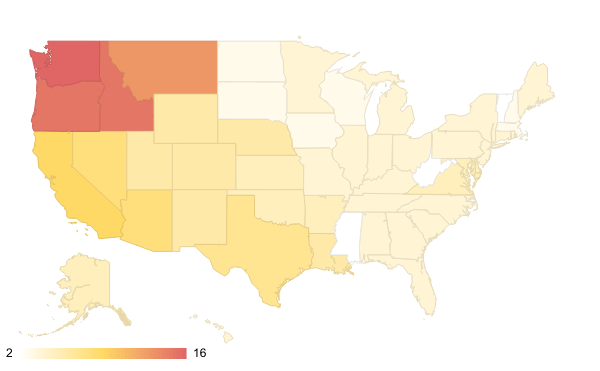
Of the 24 chains represented in the “study”, 18 of them had stores in multiple states. Looking at the number of those 18 chains that are also available in each state across the United States paints a unique look at the regional divisions throughout the U.S. The darker shade of red shows states that have the most number of chains in common with those represented in the “study”. The states with the least number of chains in common are West Virginia, Vermont, and Mississippi.
Spaghetti Sauce Packets
When I began visiting grocery stores, I always felt guilty about going into the store and walking around without buying anything. Unfortunately, I could only buy so many drinks, and didn’t have a big need for many grocery items. Eventually, though, I settled on buying one spaghetti sauce seasoning packet from each grocery store I visited – at least most of the time. In all, I bought 142 spaghetti sauce seasoning packets. Here’s how my purchases break down by brand:
| Brand | # of Packets |
|---|---|
| Best Byet | 3 |
| Essential Everyday | 13 |
| Food Club | 53 |
| Grandma’s Seasonings | 12 |
| Great Value | 4 |
| IGA | 2 |
| Kroger | 4 |
| Lawry’s | 2 |
| McCormack | 2 |
| Signature Select | 37 |
| WinCo | 10 |
| TOTAL | 142 |
 Lora Makes Things